NoverKelana · CC BY-SA 4.0
About
A striking and highly endangered species, *Nepenthes clipeata* is notable for its unique peltate leaves and large, globose pitchers. It is endemic to the near-vertical granite cliff faces of Mount Kelam in West Kalimantan, Indonesia.
Field notes
Morphology
The species is characterized by peltate leaves, where the tendril joins the underside of the lamina before the apex. Pitchers are large, reaching up to 30 cm high, and are globose at the base, becoming slightly infundibulate in the upper part. The plant produces only one type of pitcher, has short, robust stems, and is densely covered with an indumentum of long, brown hairs.
Distribution & habitat
West Kalimantan, Indonesia, specifically the near-vertical granite cliff faces of Mount Kelam, with an elevational distribution between approximately 600 and 800 m.
History & etymology
First collected in 1894 by Johannes Gottfried Hallier, who summited Mount Kelam. The name *clipeata* comes from the Latin word clipeus, meaning 'round shield,' referring to the leaf shape.
Conservation
Listed on CITES Appendix II. The species is critically rare, with historical estimates suggesting only a handful of plants remained in the wild. Ongoing conservation efforts include the Nepenthes clipeata Survival Project (NcSP) and an in situ conservation project started in 2011.
Habitat
- Altitude
- 600–800 m
- Altitude Class
- intermediate
- Native To
- Indonesia
- IUCN Status
- Critically Endangered
Taxonomy
- Described
- 1928
- Authority
- Danser
Cultivation
- Difficulty
- expert
- Temperature
- Day 22–30°C / Night 15–22°C
- Humidity
- 70–90%
Borneo Exotics 1 listing
View all →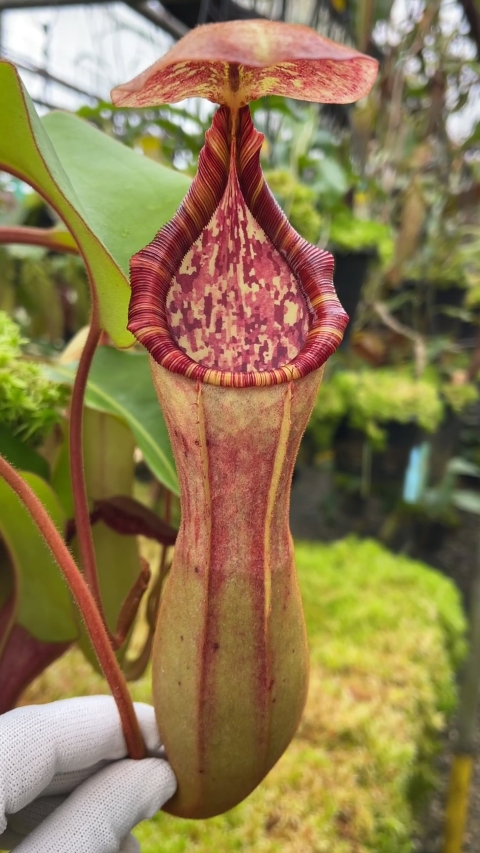
Crossed N. Clipeata with another species?
Register the cross — if it's not yet documented you'll be the first contributor. If someone already registered it, you'll be redirected to add your photo.