Alfindra Primaldhi · CC BY 3.0
About
A notable Sumatran highland species, *Nepenthes ovata* is distinguished by the hook-shaped glandular appendage found on the underside of its pitcher lid. It is a climbing plant that grows in stunted mossy forest and ridge top vegetation.
Field notes
Morphology
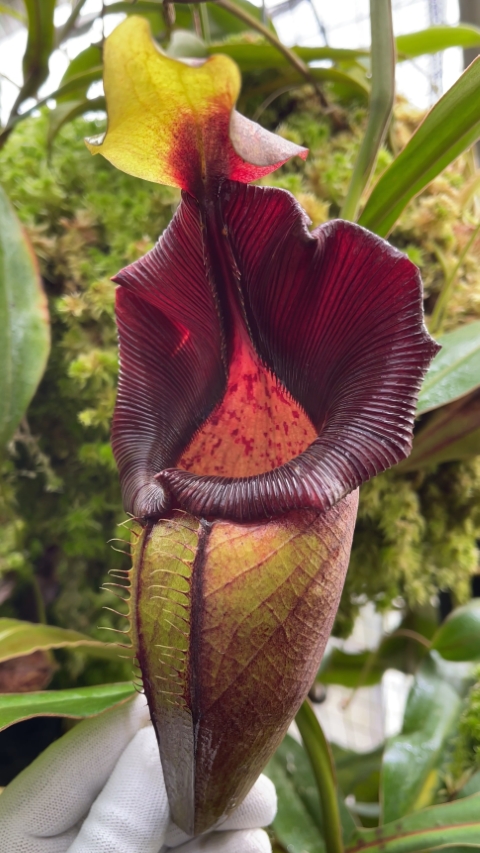
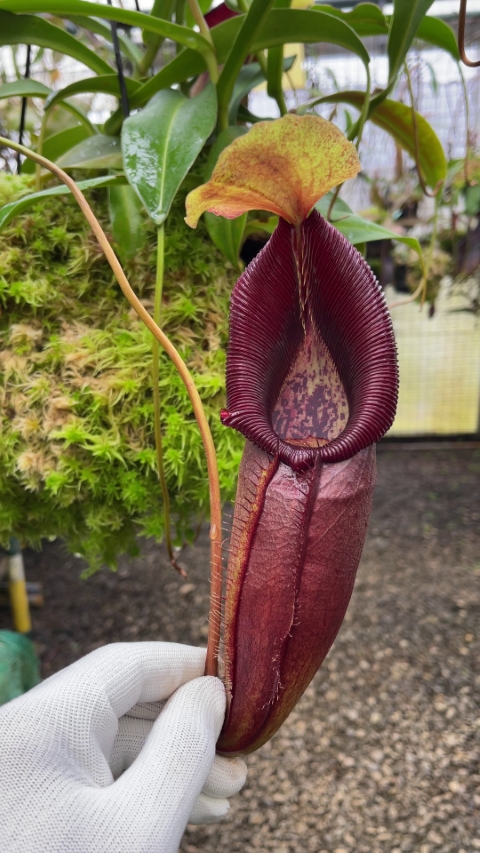
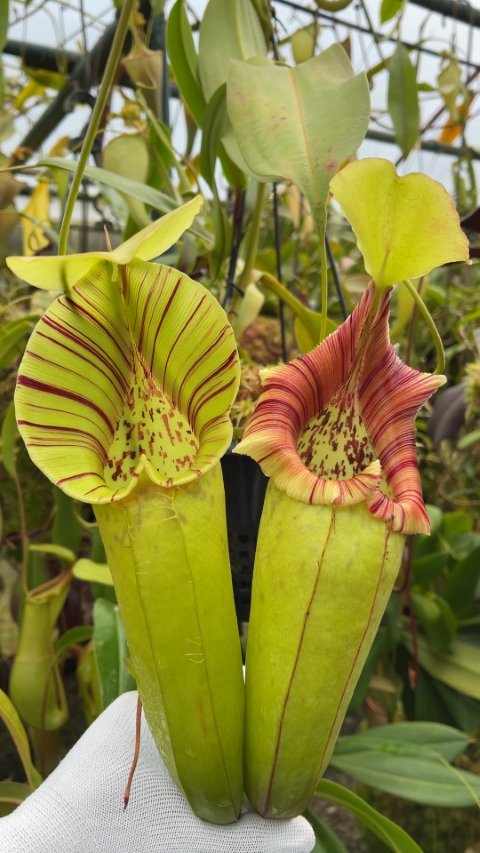
The plant is a climbing species with stems reaching 5 m and 6 mm in diameter. Leaves are coriaceous, lanceolate-spathulate, and reach 12 cm in length and 4 cm in width. Lower pitchers are ovoid, reaching 25 cm in height and 9 cm in width, featuring a fringed wing and a peristome up to 40 mm wide. Upper pitchers are cylindrical to infundibular, reaching 20 cm in length and 6 cm in width. Lower pitchers are typically green to red with a dark red peristome, while upper pitchers are yellowish-green and often have a striped peristome.
Distribution & habitat
Endemic to several mountains in North Sumatra, particularly the Lake Toba region, including Mount Pangulubao and Mount Lubukraya. It has been recorded from Mount Simanukmanuk, with an altitudinal range of 1,700–2,100 m above sea level.
History & etymology
The specific epithet ovata is Latin for "ovate," referring to the shape of the lower pitchers. The species was first collected as early as 1840 or 1841 by Franz Wilhelm Junghuhn on Mount Lubukraya. It was formally described in 1994 by Joachim Nerz and Andreas Wistuba.
Conservation
The species is currently listed as Least concern on the IUCN Red List.
Habitat
- Altitude
- 1,700–2,100 m
- Altitude Class
- highland
- Native To
- Sumatra
- IUCN Status
- Least Concern
Taxonomy
- Described
- 1994
- Authority
- Nerz & Wistuba
Cultivation
- Difficulty
- intermediate
- Temperature
- Day 18–25°C / Night 10–18°C
- Humidity
- 70–95%
Crossed N. Ovata with another species?
Register the cross — if it's not yet documented you'll be the first contributor. If someone already registered it, you'll be redirected to add your photo.